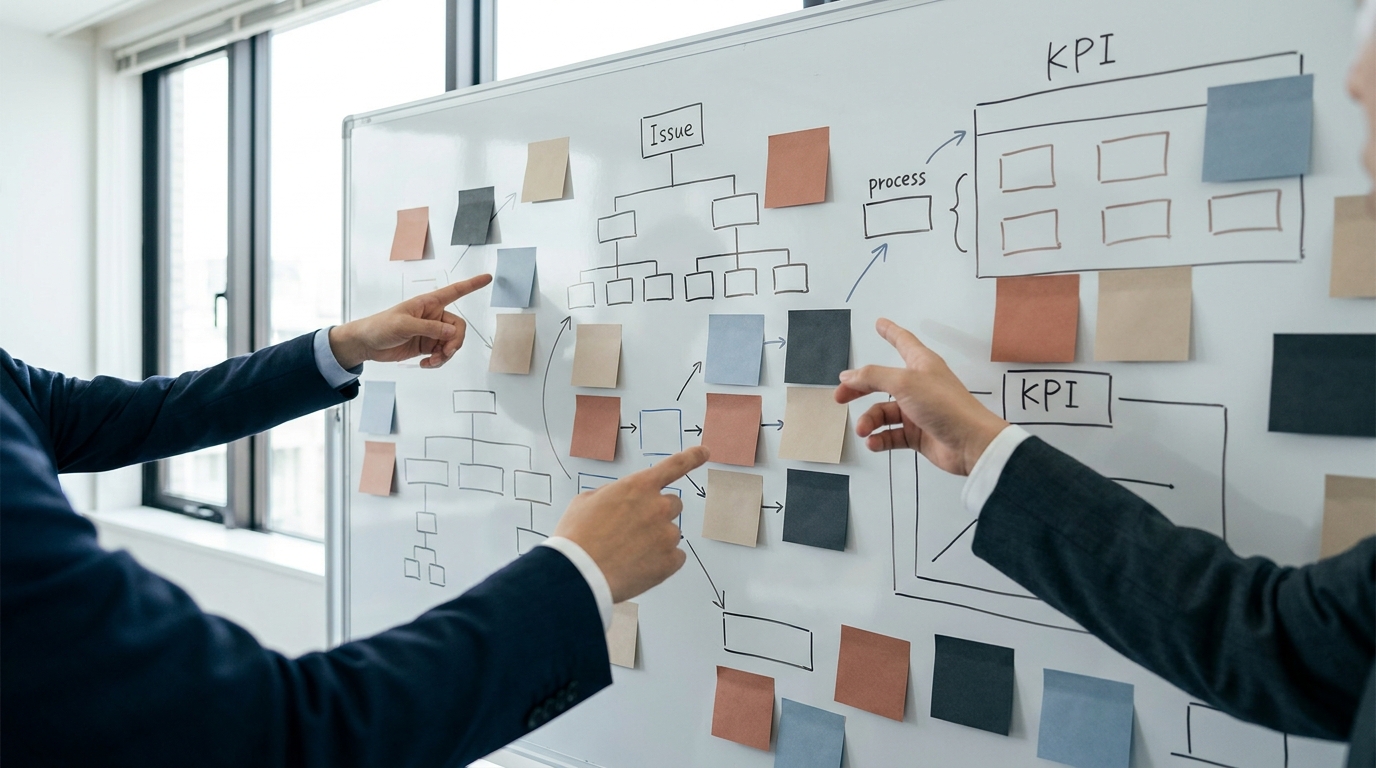
IT Consulting
Identify the source of your strength, then design the system that keeps producing it.
Our IT consulting does three things: BPR that generates competitive strength, identifying what the source of that strength is, and designing systems that create a knowledge loop where data and know-how keep accumulating. Facing both leadership and the frontline, we support you end-to-end from process reform to adoption.
ARCHITECTURE
Our vision for building a competitive foundation
The theme of IT consulting is how to build this structure itself. Starting from problem discovery, we design what goes in which layer and what to build first—drawing the whole diagram, not one layer.
How IPLoT supports this model
The areas covered by each IPLoT product and service within the model above.
| Layer | Products & services in charge |
|---|---|
| Structured-UI layer (the window) | Brain Pro / Shiftly / System development |
| Knowledge layer (what AI is taught) | iPro Manual / AI Strategist Training / Competitive Foundation Consulting |
| Activity-DB layer (store the data) | AI Data Analysis / Yomitoru-kun / Wholesale core system |
| Agent layer (where AI acts) | IPRO-kun / Menta-kun / System development |
| Designing & applying the whole structure | IT consulting (overall design) / HRobo (all layers for HR & talent) / Competitive Foundation Consulting (full rollout) |
WHAT WE DO
What our IT consulting does
Three jobs that turn your operations into a system that produces competitive strength.
BPR that generates strength
We restructure business processes—not just cutting waste, but rebuilding the flow so it produces competitive strength.
Identify the source of strength
Through problem discovery and analysis, we pinpoint which judgments in which operations are your real strength.
Design systems that create the knowledge loop
We design systems with a built-in knowledge loop, where data and know-how accumulate in-house and the AI keeps learning.
VISION
Operational improvement, and beyond.
Efficiency alone doesn't create competitive strength. We identify what the source of your strength is, then work backward from it to redesign operations, organization, and systems. The goal: a way of working with a built-in knowledge loop, where data and know-how keep accumulating in-house.
TO-BE design
Together with leadership, we paint the ideal state 5–10 years ahead. Grounded in business strategy, market environment, and the current state of the organization, we define the goal to aim for.
AS-IS analysis
From the TO-BE perspective, we take stock of current operations, data, and organization. We identify improvement priorities and the points where AI and automation should be deployed.
Transition plan
We design operational improvement, automation, and AI adoption in stages as waypoints toward the TO-BE. We walk alongside you end-to-end until it takes root in field operations.
COMPARISON
Why choose IPLoT.
Our structural strengths, compared with a typical consulting firm.
MERIT
Simplify, standardize, automate — and rebuild operations into strength.
From analysis of current operations, we clarify what is needed against the TO-BE, then support process redesign, automation, and adoption one-stop. From the design stage we build in how the freed-up time—and the data and know-how the work generates—turn into competitive strength.
Examples of effects from simplification, standardization, documentation, and automation
Cost reduction
A track record of cutting roughly 1,200 hours / 6 million yen per year through RPA and automation.
Safety
Standardization and documented procedures eliminate person-dependence and strengthen audit and compliance readiness.
Processing speed
Up to 80% less time per case, compressing the lead time for customer response.
Human error
Automation and systematization eradicate transcription and review-omission errors and curb quality variance.
STEP
How a project unfolds
STEP 1
Find the source of strength with an issue tree
Starting from management goals such as revenue targets and costs, we break the problem down and visualize the key issues. Which judgments in which operations generate your strength? We identify the source of competitive strength and the areas to invest in first.
- Decompose the issues from revenue and cost goals
- Identify the operations and judgments that are your strength
- Clarify cause and effect and focus the investment
STEP 2
TO-BE design and KPI definition
Building on the problem analysis, we work with leadership to define the ideal state 3–5 years out (TO-BE) and the KPIs that measure progress toward it. By aligning the project's overall direction and success criteria up front, we unify the decisions on the subsequent improvement, automation, and AI adoption.
- Reach agreement on KGIs / KPIs with leadership
- Structure the TO-BE business model and organizational picture
- Set AS-IS analysis priorities by working backward from the TO-BE
STEP 3
Organizing the business workflow / taking stock of frontline work
When organizing the business workflow, we diagram the flow of each process and reveal where there is duplication or unnecessary steps. Depending on the situation, we go into the field to thoroughly surface flows that cannot be put into words.
- Map the current business processes
- Identify links and overlaps between steps
- Redesign to improve overall operational efficiency
STEP 4
Clarifying the target operations
When organizing the business workflow, we diagram the flow of each process and reveal where there is duplication or unnecessary steps. Depending on the situation, we go into the field to thoroughly surface flows that cannot be put into words.
- Assess the importance and challenges of each operation
- Select the operations where improvement promises the greatest impact
- Formulate an efficient improvement plan that concentrates resources
STEP 5
Clarifying the procedures
We analyze the current work procedures in detail and ensure consistency by creating optimal procedure manuals. This prevents variation in work between individuals and enables efficient, accurate execution.
- Document the standard operating procedures for each process
- Establish a unified method of execution aimed at reducing human error
- Improve the reproducibility and reliability of the work
STEP 6
AI adoption and automation
By introducing AI technology, RPA, VBA, and the like, we automate the parts that relied on manual work and drive both faster operations and cost reduction. The efficiency gains not only shorten work time but also substantially cut operating costs, contributing to higher productivity across the company.
- Strengthen data analysis and pattern recognition with AI
- Execute processes automatically with automation tools
- Reduce human error and dramatically shorten processing time
OUR TOOLING
Our consulting comes with our own products as standard.
Our consulting runs on our own AI products — IPRO-kun and Brain Pro — as standard. Rather than relying on an individual consultant's experience, we deliver reproducible, product-backed support.
With these products, we guarantee a standardized way of working and deliverable quality that doesn't depend on an individual consultant's experience. After the system goes live, Menta-kun keeps watch over operations and continues through to improvement proposals.
FUNCTION
Who chooses us
Our consulting services are used by departments such as the following.
Sales department
Streamlining performance management, sales-material creation, contract drafting, invoicing, report preparation, and more
Development project department
Streamlining progress management, issue management, quality management, effort management, and more
Administration department
Streamlining payroll, staffing management, training planning, profit-and-loss management, cost accounting, and more
PARTNER WITH FIRMS
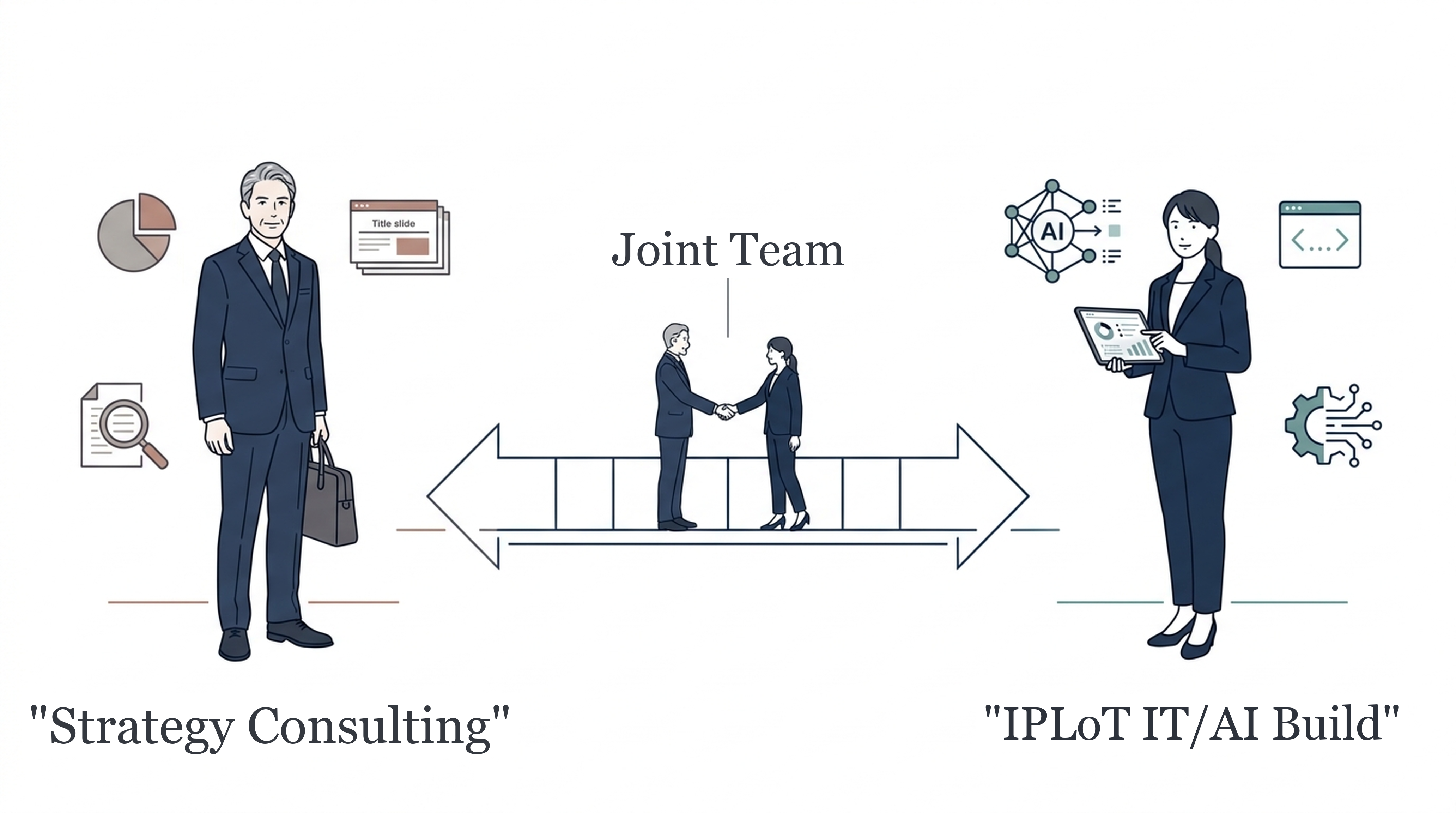
We'll work with you as a sub-contractor to consulting firms, too
We join engagements run by strategy and business consulting firms as an IT/AI-specialized sub-consultant. We can move end-to-end from upstream to implementation, working to your methods and deliverable formats.
─ ROLE 01
Taking over requirements definition and systemization concepts
We translate the TO-BE drawn up on the strategy/business side into implementable requirements, system architecture, and data models. We bring it all the way down to a requirements document that won't blow up once it's ordered.
─ ROLE 02
AI / generative AI applicability studies and PoCs
How to apply generative AI, RAG, and operational agents to your business. We design and implement everything from PoC builds and effect validation to production rollout, at a granularity that reaches the field.
─ ROLE 03
PM and hands-on support for implementation projects
Managing the vendors you order from; quality, scope, and schedule management; and walking alongside you until it takes root in the field. We head off the "the consultant writes it and it blows up while left to the vendor" scenario.
We flexibly adapt to your operations — confidentiality agreements, ownership of deliverables, and engagement model (unit participation / spot support / on-site / remote). Please feel free to consult us.

─ PUBLIC RELEASE
all published for free.
A course collection of practical know-how,
published for free.
We've published the full curriculum IPLoT uses for internal training — frontline discovery, issue trees, TO-BE design, requirements definition — as the "IT Consulting Guidebook". It comes complete with articles, exercises, and even grading rubrics, so you can use it for internal training as-is.
LECTURES
18lectures
PHASES
Ph.0–7
PDFS
80+PDFs
─ TABLE OF CONTENTS
- Ph.0IR operational challenges
- Ph.1Predicting operations from data
- Ph.2Discovery / interviews
- Ph.3Issue trees
- Ph.4TO-BE business-workflow design
- Ph.5Creating meeting materials
- Ph.6Requirements definition for field rollout
- Ph.7Project management
+ 6 supplementary courses / SUPPLEMENTS
IPLoT METHOD
From finding the problem to running it—one continuous flow.
While other firms take on just “development” or just “maintenance,” IPLoT delivers all three as one: (1) problem discovery & consulting, (2) development powered by generative AI, and (3) post-launch operations. The map below shows where each of our services sits across these three pillars.
Three parts, one offering: Discover → Build → Operate
Problem discovery & consulting
Before “what to build,” we ask “what is the real problem.” A standardized method distilled from our 36 in-house courses structures the issues on the ground.
IT consulting
Design from the goal with a standard method
AI Data Analysis
Store and clean scattered data, then turn it into action
Competitive Foundation Consulting
Verbalize know-how and implement it in AI
Development
We make the most of generative AI to go from requirements to implementation fast and at lower cost.
Operations & maintenance
We don’t just ship and leave. We keep watching the live system through its operation logs and keep improving it.
Every phase does not have to be ours. We agree the split of responsibilities—and how records are shared—with you and your existing vendors, and keep the information connected.
How we differ from a typical dev firm
| Aspect | A typical dev firm | IPLoT |
|---|---|---|
| Entry point | Builds what it’s told (spec-first) | Starts from problem discovery & consulting |
| Consulting | Relies on the individual’s experience | Repeatable via a standard method (36 courses) + Brain Pro |
| Development | Cost piles up with man-hours | Compresses build cost with generative AI |
| Operations | Passive—fixes things once they break | Menta-kun watches and proposes improvements proactively |
| Delivery | Split by phase, with gaps at the seams | One team, from discovery through operations |
“A typical dev firm” describes what commonly happens when phases are split between parties; it does not refer to any specific company.
FAQ
Frequently Asked Questions
From operational improvement, DX strategy, AI initiative planning, and requirements definition through to PMO, we cover the upstream phases broadly. We have a track record across industries — manufacturing, wholesale, services, finance, and more.
It depends on scope, but as a rough guide: an operational-improvement PoC runs 1–3 months (from several million yen), and DX strategy development runs 3–6 months (from tens of millions of yen). We also handle spot engagements such as short sounding-board sessions and third-party reviews.
Yes. The same team can move seamlessly from requirements definition into downstream development, getting it to take root in operations, and in-housing support. Rather than "drawing a picture and walking away," we focus on making it actually work in the field.
We are strong in operational improvement for wholesale, distribution, manufacturing, and IT contract/SES businesses. At the same time, we are not confined to a single industry — on cross-cutting themes like embedding generative AI into operations, we support a wide range of industries.
We can handle everything end-to-end, from upstream to implementation: operational improvement → AI adoption → business system development → in-housing support. We resolve the common split where consulting and development sit in separate companies, philosophies drift apart, and projects blow up — by keeping it all in-house.
Yes. We have a track record of joining projects as an IT/AI-specialized sub-consultant on engagements run by strategy and business consulting firms. We can carve out the "IT-involved processes" as a unit — requirements definition, systemization concept design, PoC builds, AI-applicability studies, PM of implementation projects, and more. We can also work to your methods and deliverable formats. Please consult us regarding confidentiality and contract structures.
Yes. Drawing on our experience as a development company, we serve as a client-side PMO covering estimate-validity assessment, requirements management, progress/quality/scope management, and risk handling. Rather than squeezing vendors as subcontractors, we align requirements and assumptions and build a cooperative relationship as we proceed. We can also walk alongside your team — conveying how to run things and connecting it to in-housing. A development-savvy team sits in the middle to prevent the split where "the consultant draws it up and then leaves it to the vendor, and it blows up."
FREE TOOLS
Start with our free tools to see where you stand
No sign-up, completely free. Try our AI Adoption Diagnosis and a rough estimate for your business-system development costs right now. A handy starting point before you reach out.