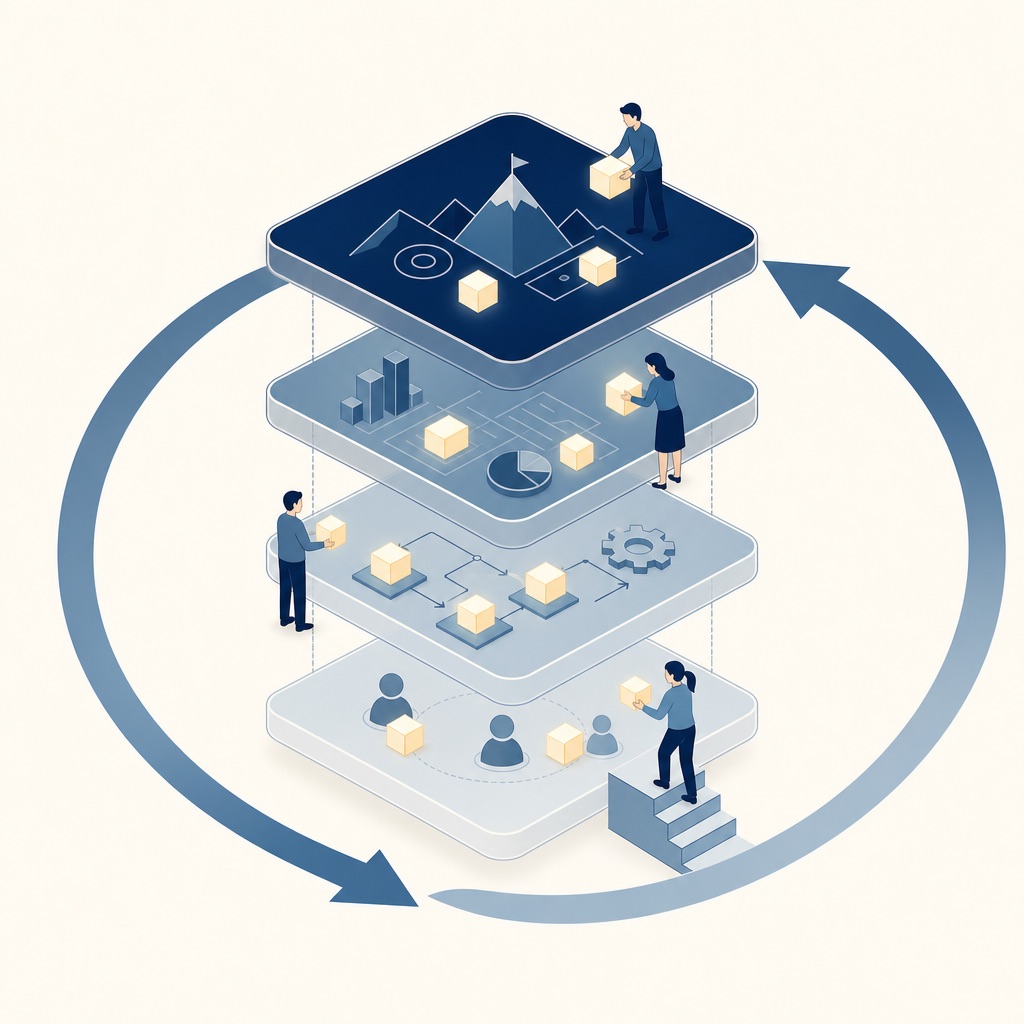
Competitive Foundation Consulting
Turn your know-how into AI-powered competitive advantage. The gap widens with every year of use.
Anyone can use the same AI models — your competitors included. What separates companies is whether the results of use — the criteria for judging work as good or bad — accumulate inside the organization. This service builds the four-step knowledge loop (collect, structure, teach, implement) inside your company, growing AI into something that creates your competitive advantage. We bring in the platform and materials-production method IPLoT itself runs in production, launching in a standard 16 weeks with no development phase.
WHY NOW
AI adoption is entering its third stage
After “using” and “deploying” comes the stage where AI builds your company’s competitiveness. Generative AI itself is now everywhere; the next frustration is that nothing from its use stays with the organization — what gets outsourced has shifted from manufacturing capability to organizational knowledge.
Stage 1 · from ~2023
“Using” ChatGPT
Individuals ask questions and draft text in chat. The effect stops at personal productivity.
Limit: nothing from that usage stays with the organization
Stage 2 · from ~2025 — most companies are here
“Deploying” AI agents
Agents handle research, document drafting, and routine work. Deploying one is something any company can do.
Limit: your competitors can use the same agent — no differentiation
Stage 3 · what comes next
AI that builds your company’s competitiveness
The results of usage — your criteria for what makes work good or bad — accumulate in verbalized form, and AI runs on your company’s own know-how. The gap widens with every year of use.
Standing this up together is what this service delivers
- In expert-dependent, knowledge-intensive firms, one resignation erasing core know-how has become a board-level risk.
- Structural succession pressures are a tailwind: veteran retirements, labor shortages. Succession and labor-saving themes also align with subsidies, making the investment easier to justify internally.
- Building stage three alone is heavy — IPLoT brings the platform and the materials-production method, so you can focus on verbalizing your judgment criteria.
BACKGROUND
The real issue isn’t whether to use AI — it’s whether the organization learns from the results
In the industrial hollowing-out of the 1970s onward, manufacturing functions, jobs, and industrial infrastructure moved to lower-cost regions. What is happening now is the hollowing-out of organizational knowledge (2024–): knowledge, judgment, and know-how become dependent on external AI and stop accumulating in-house. If you only use it, the one learning is the external AI — nothing stays inside.
Manufacturing functions, jobs, and infrastructure were externalized to lower-cost regions.
Knowledge, judgment, and know-how become dependent on external AI and stop accumulating in-house.
The fix is to run all four steps on your own platform: (1) collect — data accumulates just by working; (2) structure — people give it structure; (3) teach — people verbalize it; (4) implement — materials become prompts. Every lap grows the internal knowledge the AI can reference — and if even one of the four is missing, the know-how never stays with the organization.
KNOWLEDGE LOOP
Collect, structure, teach, implement — a loop that runs inside your company
Completing the collection, structuring, and materials-production of internal activity data in-house, and evolving the AI into one packed with your know-how — that is the knowledge loop. The AI models (such as Claude) are external, but the results of use return as your prompts — your know-how — and the AI evolves on it.
GOAL
Higher project quality
Data accumulates just by working
Conversations, meetings, tasks, and documents are collected automatically into a single database. Zero manual input.
ipro-db
People give it structure
Workflows, issues, and tasks become one interlinked structured dataset — readable and writable as the AI’s long-term memory.
Brain Pro, etc.
People verbalize it
What is good, what is bad, why, and when it transfers — captured as teaching material. Only then does it become something an AI can be taught.
Materials & tests
Materials become prompts
Materials = prompts are managed in a database, and only the knowledge relevant to the context is fed to the AI. Update a material and the AI gets smarter instantly.
ipro-agent
Conversations, meetings, tasks, and documents are collected automatically into a single database. Zero manual input.
Workflows, issues, and tasks become one interlinked structured dataset — readable and writable as the AI’s long-term memory.
What is good, what is bad, why, and when it transfers — captured as teaching material. Only then does it become something an AI can be taught.
Materials = prompts are managed in a database, and only the knowledge relevant to the context is fed to the AI. Update a material and the AI gets smarter instantly.
Work with the now-smarter AI — and the loop returns to (1)
Every lap grows the internal knowledge the AI can reference
ARCHITECTURE — models stay external, know-how stays yours
The four layers behind the knowledge loop
Structured-UI layer
Built per company
The layer that stores your know-how as structure. IPLoT uses Brain Pro (swappable with existing tools such as Backlog). This is also where people review and correct what the AI knows.
Activity-DB layer
Shared SaaS platform
The layer that collects internal activity data automatically. Chat, tasks, and meeting recordings are unified into a single database (ipro-db). Zero manual input, and the data structure is company-agnostic.
Knowledge layer
Built per company
The layer where people create what the AI is taught — the criteria (know-how) for judging output as good or bad. Records of past work are abstracted, down to the reasons behind each judgment, into teaching materials.
Agent layer
Built per company
The layer that stores materials as prompts in a database (ipro-agent). A knowledge-retrieval agent pulls only the materials the current context needs and hands them to the AI.
If even one of the four is missing, know-how never stays with the organization
① Collect
Without this: there is no raw material at all
② Structure
Without this: it stays an unusable pile of logs
③ Teach
Without this: it never becomes teachable to an AI
④ Implement
Without this: materials sit unused and die on the shelf
Since anyone can use the same model, what separates companies is whether they have the machinery to keep this loop turning. Models are replaced every year; your activity data and materials keep stacking up.
SERVICE
What we provide: building the knowledge loop inside your company
The core is verbalizing your know-how. We build the knowledge and agent layers, connect the structured-UI layer, and reuse the production-ready activity-DB SaaS as-is — so the standard 16-week rollout consists of connection, verbalization, and tuning (no development phase).
Activity-DB layer
Shared, production-ready SaaS
Only tenant issuance and connection setup. Multi-tenancy, per-company isolation, three-level permissions, nine collection channels, and per-company AI budget/model settings are already running in production. No additional development — a monthly subscription is all it takes.
Structured-UI layer
We connect
We connect to the management tools and processes you already use. If nothing fits, IPLoT studies your existing setup and builds the structured-UI layer itself (Brain Pro is one such build).
Knowledge layer
The core of the service: verbalization
In workshops, we verbalize your criteria for judging work as good or bad — your know-how — and turn them into teaching materials. Most of the value of the engagement is decided here.
Agent layer
We tune
We turn the knowledge layer (materials) into prompts and implement them in AI. Answers, always-on monitoring, morning briefings, and deliverable generation (5–10 selected from 28 types) all run on these prompts.

- The standard 16-week rollout is completed through connection, verbalization, and tuning — up and running in about four months with no development (building a new structured-UI layer is proposed separately).
- Pricing is a simple structure: implementation support (verbalization) + monthly fees (SaaS, hands-on support, AI usage).
- The materials, prompts, and data created all belong to your company.
COMPARISON
How this differs from other approaches
The differentiating axes are verbalizing judgment criteria and measuring retention. Search and storage alone cannot reproduce quality standards.
| Aspect | Notion + ChatGPT / internal wiki | KM SaaS (Q&A archive) | Internal ChatGPT + RAG | Major consultancy KM support | Knowledge Loop |
|---|---|---|---|---|---|
| Collection — does it accumulate just by working? | ×People must write it down | △Depends on posting | ○Indexes existing documents | ×Methodology only | ◎Nine channels collected automatically, zero manual input |
| Verbalizing good/bad judgment criteria | ×Never gets written | ×Q&A fragments | ×Nothing beyond the documents | △Only during the engagement | ◎Verbalized in workshops and turned into materials (the core of this service) |
| Does AI flow back into daily work? | △Generic chat | ×Search only | ○Search and answer | ×— | ◎Answers, monitoring, 28 types of deliverable generation |
| Measuring retention | ×— | ×— | ×— | △Training metrics are separate | ◎Tests, AI grading, weak-point maps |
| Does a platform remain to keep the loop turning? | ○The tool remains | ○The tool remains | ○The mechanism remains | ×The methodology remains | ◎The whole loop remains, and materials keep growing |
Search and storage alone cannot reproduce your criteria for judging work as good or bad. This service delivers everything in one loop — from verbalizing judgment criteria to measuring retention. (The table is a summary of general tendencies.)
FOR WHOM
Target companies
Knowledge-intensive firms whose know-how is the product, and field-work companies where judgment happens verbally, on paper, or by phone — the entry points differ, but both are the knowledge loop’s home ground.
(1) Knowledge-intensive — companies whose know-how is the product
Consulting, marketing agencies, professional services, M&A advisory
15–100 peopleTypical pains: proposal quality depends on star performers; when a star leaves, core know-how leaves too; new hires take a year to stand on their own. Verbalizing the knowledge layer is the lead act — the agent distributes the codified judgment criteria to everyone through proposal reviews, similar-case search, and deliverable generation.
How to start: knowledge-asset assessment → PoC (one expert × one theme turned into materials + answer demo)
Contract development, system integrators, web production
20–150 peopleTypical pains: estimate and requirements quality depends on the PM; lessons from troubled projects stay with individuals. IPLoT’s 36 courses can be reused as a foundation as-is, so adoption is fastest in this segment.
How to start: in-house training license + workshops → extend to the agent layer

The prerequisite is that daily work flows as text — chat, meeting recordings. The success condition is 2.5 hours a week from your top performer. We confirm both together during the assessment.
(2) Field work — companies where judgment happens verbally, on paper, or by phone
For field work, it isn’t “connect and it accumulates” — we first retrofit recording and ingestion onto existing routines to create a place where it accumulates. Logistics piggybacks on the legally required roll call; multi-site services on HQ-store chat — collection starts without adding new habits.
| Industry | Know-how = good/bad judgment criteria | Creating a place where it accumulates (collection entry point) |
|---|---|---|
Small/mid manufacturing Make-to-order, 20–100 people | Pass/fail inspection calls, changeover conditions, fault isolation, estimating labor hours | Record morning meetings, process meetings, and defect reviews → automatic transcription. Record expert interviews themselves as primary material. Ingest shop-floor LINE chats |
Construction Specialty contractors, 10–80 people | Quantity take-offs and margin rates, scheduling (crew and weather), safety calls, quality pass/fail lines | LINE groups are the de-facto standard — the one field segment close to “connect and it starts accumulating.” Plus estimate spreadsheets, safety documents, and recorded review meetings |
Wholesale Specialty trading, 30–150 people | Pricing margin intuition, substitution proposals on stock-outs, choosing suppliers, credit decisions | Outcomes (prices, orders) stay in the core system but the reasons do not → record pricing meetings and supplier reviews to capture just the reasons |
Logistics Regional carriers/3PL, 30–200 people | Dispatch planning (vehicle class, licenses, pairings, return loads), exception handling, per-shipper unwritten rules | Piggyback recording on the legally required roll call and morning dispatch check — a place for verbalization with almost no new habits. Recorded interviews on per-shipper rules, daily reports |
Multi-site services Retail, food service, care — 5–30 sites | Order-volume reading, floor/shift planning, first response to complaints, (care) noticing changes in condition | Ingesting HQ-to-store chat is the first move. Record store-manager meetings and supervisor visits. High turnover → shift the weight toward measurable tests |
For field-work companies the rate-limiters are digitizing the data source and employee consent to recording (for succession, not surveillance) — we make consensus-building a required early step. Veterans “won’t write it but can talk about it” — IPLoT does the verbalizing, and they review. Investments in skills succession and labor savings can sometimes be combined with subsidies.

PROCESS
How implementation proceeds: 3-week assessment + ~4 months + ongoing operation
Six phases along the four layers. General members carry almost zero load; what we borrow is the expert’s 2.5 hours a week. From Phase 1 onward, technical work is limited to connection, configuration, and prompt loading (no new development).
Phase 0 Assessment
ASSESS
Phase 1 Collection
COLLECT
Phase 2 Structuring
STRUCTURE
Phase 3 Materials
★ THE CORE
Phase 4 AI implementation
DEPLOY
Phase 5 Operation
LOOP
The rate-limiter is the knowledge-layer workshop (one postponement delays everything by a week), so the full calendar is booked with the executive sponsor at contract signing. Your total load is 2–3 core people × 20–30 hours over 16 weeks — everyone else continues business as usual.
PHASE 3 DEEP DIVE
The materials workshop — IPLoT does 80% of the verbalizing
This is the inside of Phase 3, where most of the engagement’s value is decided. Your experts only judge and red-pen.
- IPLoT pre-extracts good/bad example candidates from the activity DB and past projects into workshop material — we never ask you to start from a blank page.
- Materials are produced with IPLoT’s method as the template: name removal, abstraction into fictional-company scenarios, and generation of quizzes, written tasks, and grading rubrics (the same method used for our own 36 courses).
- The expert’s load is a 90-minute workshop plus 60 minutes of red-penning = 2.5 hours per week. We never design beyond that.
We don’t aim for 36 courses from day one. One business area × 3 deliverable types × 5 materials completes a first lap in 4 weeks — so you feel the AI’s answers change first.
8–12courses
Initial set (3 priority themes × 3–4 each)
40–60questions
Quizzes (question-bank format)
15–25tasks
Written tasks + AI grading rubrics

Acceptance is about reproducibility, not volume
- A junior member solves the written tasks unseen; if AI grading and expert grading agree within tolerance (e.g., ±15 points on 80% of items), it passes.
- The expert personally signs off — “I’d hand this to a new hire.” Acceptance requires both the numbers and the sign-off.
If the workshop can’t be held twice in a row, we pause into “accumulation standby.” Collection keeps running automatically, so there is more material when you resume — pausing is designed to cost you nothing.
─ KNOWLEDGE LOOP
TRACK RECORD
Implemented and running at IPLoT
This loop is not a concept — it is the system IPLoT itself runs in production. All four layers are built in-house, and our daily work runs on top of them.
ipro-db: Slack, meetings, tasks, and documents — all in one database
 Slack channel logs
 Huddle AI notes (Canvas)
 Meeting recordings → auto transcripts
 Attachment OCR
 Google Docs (read with the user's permission)
 Scheduled crawling of public URLs
 Backlog / Linear / Trello tasks
 LINE / Google Chat messages
 Calendars & bookings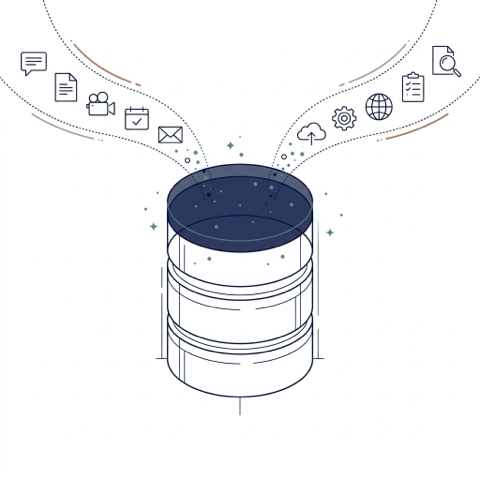
Unified into one knowledge base
All data vectorized and stored for semantic search (zero manual input)
Chat
Slack / LINE / Google Chat logs
Meetings
Recordings, transcripts, huddle AI notes
Tasks
Backlog / Linear / Trello (with source URLs)
Documents
Google Docs, attachment OCR, public URLs
People & projects
Who did what, on which project
ipro-db is the activity-DB layer. Just by working as usual, the data that becomes your company's knowledge stacks up every day with zero manual input. It is industry- and company-agnostic, so it can be deployed at your company as-is (the AI functions are handled by (4) ipro-agent).
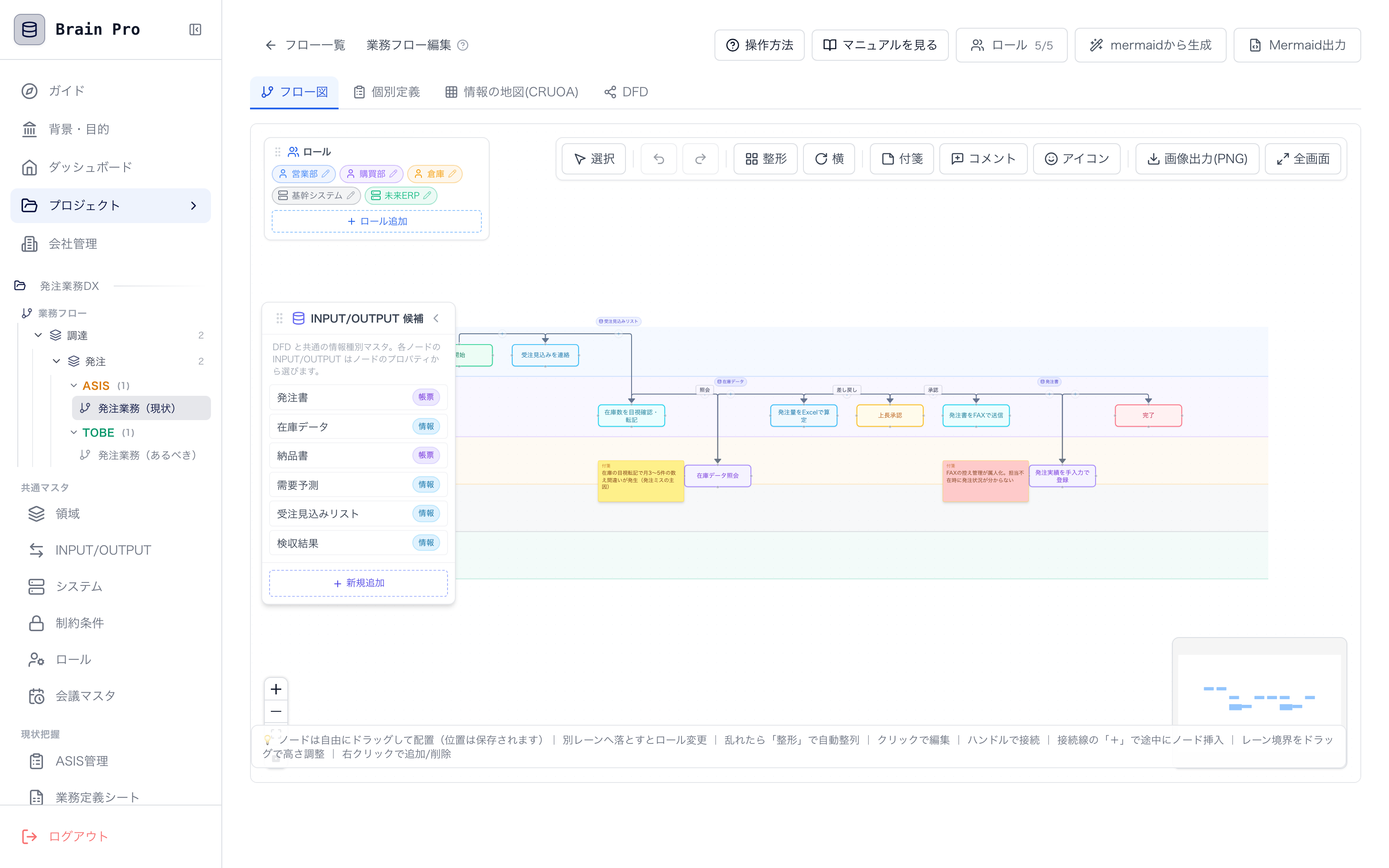
View serviceBrain Pro: Upstream project information as one structured dataset
Workflows, gaps, issue trees, WBS, and risks are managed as one interlinked dataset. The AI reads and writes this data directly — proposals no longer scroll away in chat; they become structured assets.
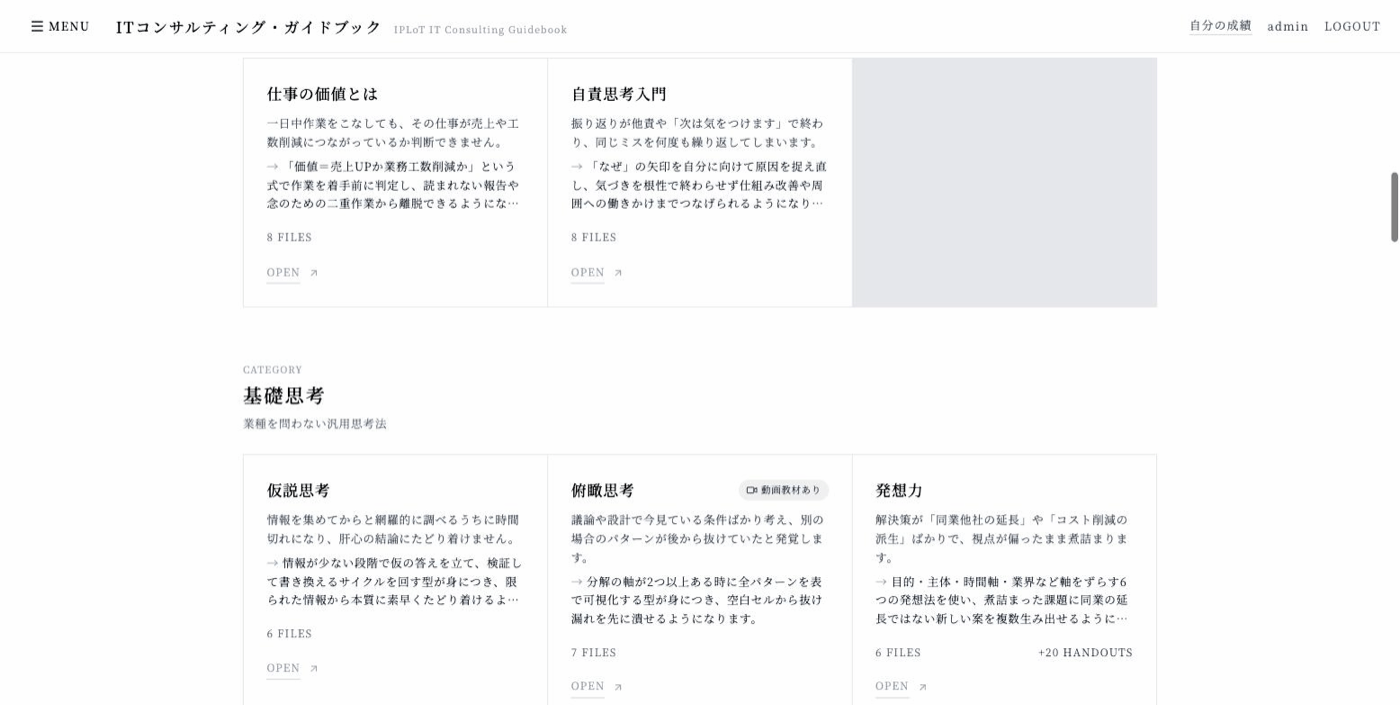
In-house training: 36 courses built from past-project data × human abstraction
36courses
Consulting craft, foundational thinking, system design, management, Claude Code
220questions
Multiple-choice quizzes (pass mark: 80)
243tasks
38 written tests, AI + admin grading
Real project work is abstracted into fictional-company scenarios and run with the full measurement infrastructure — quizzes, written tests, AI grading, and weak-point maps. The materials are not reading matter but measurable knowledge, and they double as the prototype of the AI’s prompts.
ipro-agent: Materials held as prompts in a DB; only context-relevant knowledge reaches the AI
 Prompts verbalized from the 36 in-house courses
 Brain Pro structures (flows, issues, tasks)
 ipro-db records (chat, meetings, tasks, docs)Monitoring policies & deliverable recipes
 Tools visible via MCP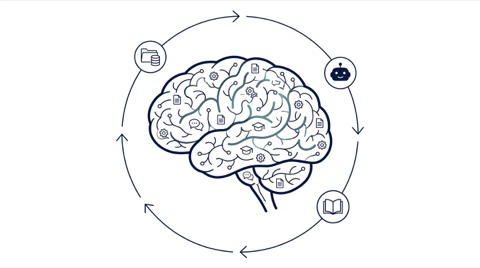
ipro-agent
All prompts managed in a DB A retrieval agent supplies only what the context needs
Answers to questions
Answered with sources (recorded)
Always-on monitoring & proposals
Reads channels daily, proposes next moves
Morning briefings
Time and days set per company
Auto-generated deliverables
28 types: minutes, estimates, workflow diagrams…
Writes to tools
Decides where and how, on the spot (MCP)
The AI is never fed all 36 courses at once. A knowledge-retrieval agent pulls only the materials the current context needs from the prompt DB. So answers, monitoring, and deliverable generation all run from the same single prompt DB — one place to fix.
View servicePRICING
Pricing guide
A three-step structure: start with an assessment, verbalize during implementation, and keep the loop turning in operation (SaaS + hands-on support).
* Excluding tax. Individually quoted by company size and number of themes.
Menu
What you get
Price
Effort guide
⓪ AI-adoption assessment
Web, free
① Knowledge-asset assessment
Phase 0
② PoC
Optional
③ Implementation package
Phases 1–4, ~4 months
④ Operation
Phase 5, monthly
First-year guide: roughly ¥6–7.5M for assessment + implementation + operation; from year two, operation only (monthly fee + AI usage). AI usage is capped, so there are no surprise bills.
To protect quality, we take on at most two implementations at a time. Slots are offered in order.
KPI
How results are measured
Answer logs, source records, and AI grading are already built into the platform, so most KPIs are measured automatically. BEFORE values are measured during the assessment, and targets are agreed with you at that point.
| KPI | How it is measured (automatic after launch) | Target guide |
|---|---|---|
| New-hire ramp-up time | Months to pass the tests and complete a first project unaided (question-bank tests + AI grading) | 30% shorter |
| First response to questions | Share resolved by AI answers with sources (answer logs, source records) | 50% resolved by AI |
| Deliverable drafting time | First-draft time using deliverable auto-generation (usage logs) | First drafts 50% faster |
| Detecting shelved materials | Prompt-DB references per month, skew by course | 80% referenced monthly |
| Know-how retained at departure | Share of a 20-question set answerable with AI + materials alone after the person leaves | 80%+ |
| Raising judgment across the team | Same-bank test scores and weak-point-map movement after six months (rubric-based AI grading) | Top-3 weak tags replaced |
A “fire drill” that doesn’t wait for a resignation: once every half year, we pause questions to the expert for one week and confirm the business still runs — verifying that the know-how now lives with the company.
DATA & CONTRACT
Data handling and our commitments
The materials, prompts, and data created are all yours. Confidentiality is protected through per-company isolation and opt-in collection.
- Deliverables belong to you — materials, prompts, and the judgment-criteria catalog. IPLoT’s materials-production method and templates are reserved as background IP, with the boundary itemized in an annex.
- The platform (ipro-db / ipro-agent / Brain Pro) is licensed as SaaS only; source code is not disclosed.
- Data return on termination: all activity-DB data, materials, and prompts exported in machine-readable form, with deadlines and deletion certification written into the contract.
- Tenants are isolated per company with three permission levels. Scope and form of provision are defined in a contract annex.
- Even when we serve companies in your industry, your materials and data are never reused (the method may be; the content may not).
- External AI is used via commercial APIs under no-training terms. IPLoT itself never reuses your materials or data in services for others.

Third-party confidentiality — the key issue for consulting & agency clients
- Your chats carry your clients’ confidential information. Collection is opt-in per channel (the default is “do not collect”). We ask you to confirm whether your NDAs permit storage in an external SaaS.
- When producing materials, real names and figures are replaced with fictional-company scenarios — the materials method itself acts as an anonymizer.
IPLoT METHOD
From finding the problem to running it—one continuous flow.
While other firms take on just “development” or just “maintenance,” IPLoT delivers all three as one: (1) problem discovery & consulting, (2) development powered by generative AI, and (3) post-launch operations. The map below shows where each of our services sits across these three pillars.
Three parts, one offering: Discover → Build → Operate
Problem discovery & consulting
Before “what to build,” we ask “what is the real problem.” A standardized method distilled from our 36 in-house courses structures the issues on the ground.
IT consulting
Design from the goal with a standard method
AI Data Analysis
Store and clean scattered data, then turn it into action
Competitive Foundation Consulting
Verbalize know-how and implement it in AI
Development
We make the most of generative AI to go from requirements to implementation fast and at lower cost.
Operations & maintenance
We don’t just ship and leave. We keep watching the live system through its operation logs and keep improving it.
Every phase does not have to be ours. We agree the split of responsibilities—and how records are shared—with you and your existing vendors, and keep the information connected.
How we differ from a typical dev firm
| Aspect | A typical dev firm | IPLoT |
|---|---|---|
| Entry point | Builds what it’s told (spec-first) | Starts from problem discovery & consulting |
| Consulting | Relies on the individual’s experience | Repeatable via a standard method (36 courses) + Brain Pro |
| Development | Cost piles up with man-hours | Compresses build cost with generative AI |
| Operations | Passive—fixes things once they break | Menta-kun watches and proposes improvements proactively |
| Delivery | Split by phase, with gaps at the seams | One team, from discovery through operations |
“A typical dev firm” describes what commonly happens when phases are split between parties; it does not refer to any specific company.
FAQ
Frequently Asked Questions
The main ask is 2.5 hours per week from your top performers: two experts × 2.5 h/week × 8 weeks (a 90-minute workshop plus 60 minutes of red-penning). The executive sponsor joins the kickoff and monthly reviews and makes the final call on themes; IT needs about 2 hours a week until week two (connection approvals). General members attend a one-hour kickoff only — zero added daily work (collection is automatic).
The standard schedule is a 3-week assessment plus roughly 4 months (16 weeks) of implementation. Costs: knowledge-asset assessment ¥0.5–0.8M (fixed), implementation package ¥3.5–5M (light version ¥2.8M), operation ¥200–300K/month plus capped AI usage. First-year guide: about ¥6–7.5M; from year two, operation only. (All excluding tax; individually quoted by size and themes.)
Not at all. IPLoT does 80% of the verbalizing for you. We pre-extract good/bad example candidates from the activity DB and past projects into workshop material, so no one starts from a blank page. All we ask of the expert is judging and red-penning.
If the workshop can’t be held twice in a row, we pause into “accumulation standby.” Collection keeps running automatically, so there is more material when you resume. AI costs are auto-capped by a per-company budget, so nothing balloons while paused.
Collection is opt-in per channel, and the default is “do not collect.” We build the exclusion list together during the assessment. When producing materials, real names and figures are replaced with fictional-company scenarios — the method itself acts as an anonymizer. External AI is used only via commercial APIs under no-training terms.
Materials, prompts, the judgment-criteria catalog, and the activity-DB data all belong to your company. On termination we export everything in machine-readable form, with deadlines and deletion certification written into the contract. Even if IPLoT serves companies in your industry, your materials and data are never reused.
No switch needed. The structured-UI layer connects to the management tools you already use by default; only if nothing fits does IPLoT build one (Brain Pro is one such build). The knowledge loop layers on top of your existing setup.
For field-work companies we make it a required early step to explain internally that recording is for skills succession, not surveillance. IPLoT prepares the explanation materials and works through the consensus-building with you. The design piggybacks on existing habits such as roll calls and morning meetings, adding almost no new ones.