Shining a light on
hidden contributions with "HRobo"
An AI agent that reads each person's work — buried in your Slack and Teams —
and turns it into a "talent report."
The team grows, remote work gets mixed in, and one person can no longer grasp it all. From your daily communication, HRobo surfaces the "quiet supporters," the "early signs of hard-to-voice unease," and the "unnoticed strengths" — each with its evidence.
ARCHITECTURE
Our vision for building a competitive foundation
Every IPLoT product and service takes a place in this shared OS of competitive strength. HRobo covers the highlighted part (Structured-UI layer + Knowledge layer + Activity-DB layer + Agent layer).
How IPLoT supports this model
The areas covered by each IPLoT product and service within the model above.
| Layer | Products & services in charge |
|---|---|
| Structured-UI layer (the window) | Brain Pro / Shiftly / System development |
| Knowledge layer (what AI is taught) | iPro Manual / AI Strategist Training / Competitive Foundation Consulting |
| Activity-DB layer (store the data) | AI Data Analysis / Yomitoru-kun / Wholesale core system |
| Agent layer (where AI acts) | IPRO-kun / Menta-kun / System development |
| Designing & applying the whole structure | IT consulting (overall design) / HRobo (all layers for HR & talent) / Competitive Foundation Consulting (full rollout) |
HRobo covers: Structured-UI layer + Knowledge layer + Activity-DB layer + Agent layer
PROBLEM
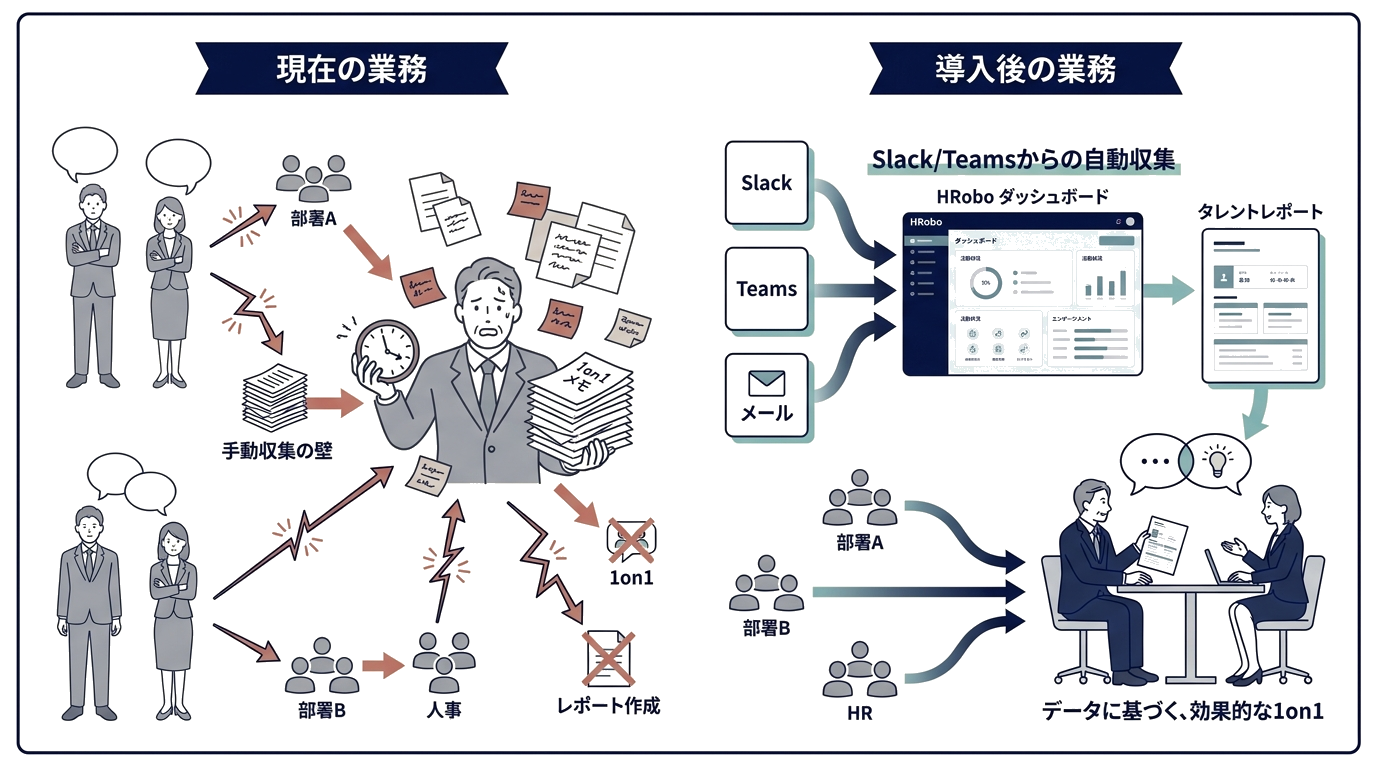
Before management can no longer keep up
The team grows, remote work mixes in, and the half-yearly cycle can't capture it all. Many organizations hit the very same wall.

You can't see who's doing what
The team grows, and remote work gets mixed in. There's no longer anyone who can grasp the full contents of every single person's work.

The hard-to-voice unease never reaches you
Grievances people don't say out loud, and the quiet signs of mounting workload. They don't come up even in 1on1s — and by the time you notice, the disengagement has already begun.

Once every six months is already too late
Half-yearly review cycles can't keep up with how people and organizations change. The moment you want to make a call, the basis for it isn't there.

The quiet supporters fall through the evaluation cracks
Only the loud voices stand out, while the contributions of those quietly keeping the organization running never make it into the data.
WORKFLOW
From scattered HR information to a unified profile.
Centralize dispersed histories, skills, and evaluations to enable data-driven placement and development.

The ones who don't raise their voice
are the ones keeping the organization running.
ABOUT
What is HRobo
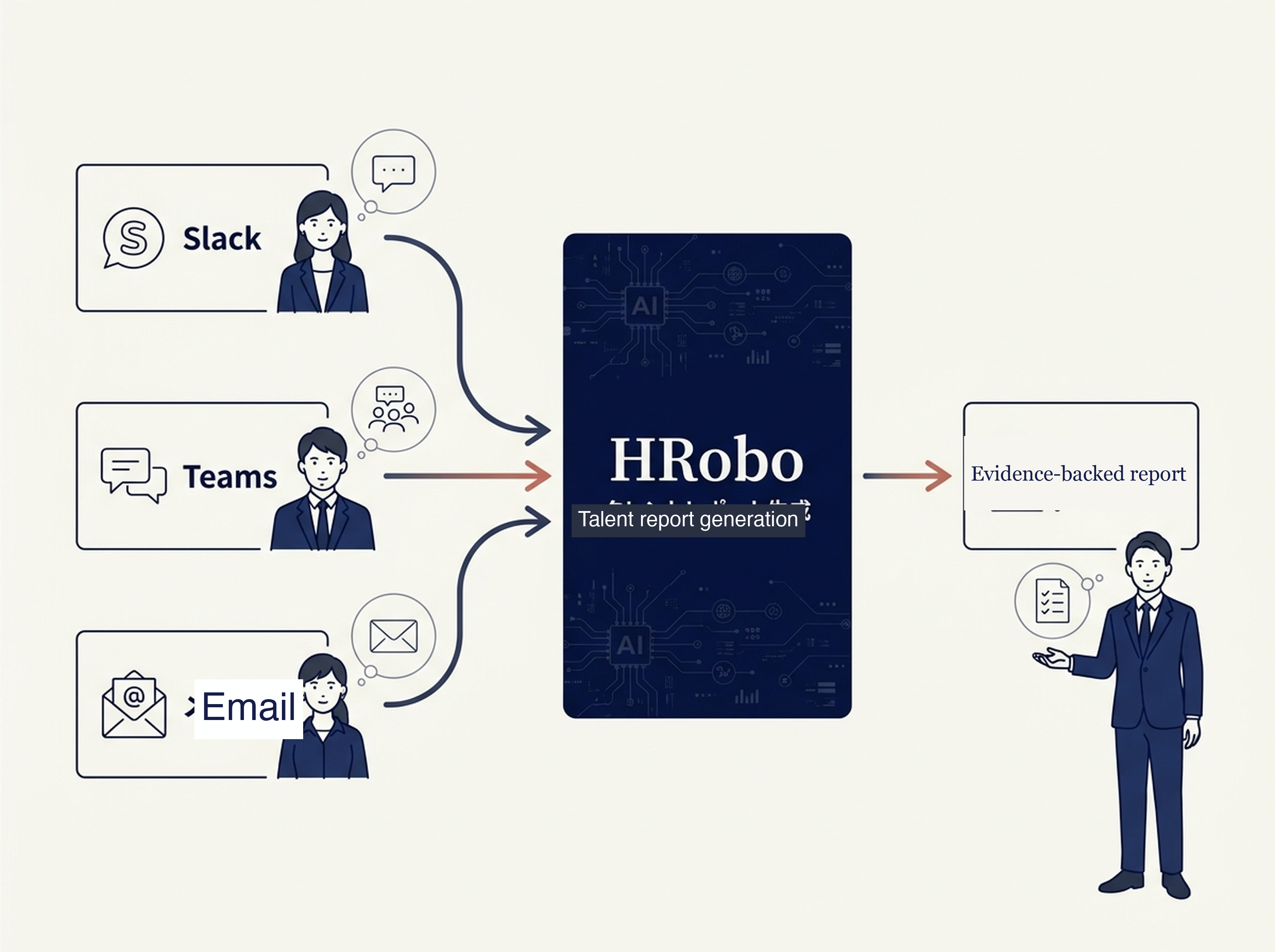
HRobo is a talent management solution that connects to Slack, Teams, and email and reads each member's work as a "talent report."
Without forcing new work on the frontline, it surfaces the normally-invisible contributions, strengths, and early signs of unease from the words already exchanged in the course of work. Reports organize "recent topics," "strengths," and "signs worth watching" per observation axis. They update automatically on any cycle from daily to monthly, and can be generated manually whenever you need.
Every statement always carries a link back to the message it's based on. That's why it becomes shared reference material for dialogue — material you can even show to the person themselves.
WHAT'S IN A REPORT
What is a talent report
A compilation of "strengths," "recent topics," and "signs worth watching" per observation axis, written in evidence-backed prose. Key statements come with links back to the messages they're based on.
TALENT REPORT
Taro Tanaka
Sales Dept. 1 / Senior Manager
PERIOD
2026.04
─ OBSERVATION 01
Building trust with customers
In negotiations with major clients, a consistent pattern of anticipating the counterpart's approval process and preparing materials ahead of time[1]. In new-business development, the quality of upfront research is also high[2].
Since mid-April, running 3 new deals in parallel, yet maintaining the frequency of progress sharing[3].
Since late this month, reply times to internal members have grown longer than usual. Possible sign of rising workload[4].
─ OBSERVATION 02
Developing junior members
… continues
* Sample display. Actual reports are generated from your observation-axis templates and the messages ingested.
─ COMPONENT 01
A section per observation axis
Organized into independent sections for each observation axis you define. You can use different templates for sales, engineering, and more.
─ COMPONENT 02
Strengths / Recent topics / Signs worth watching
Organized into three perspectives per observation axis. Concrete facts that numeric scores alone can't show are added in prose.
─ COMPONENT 03
Evidence links on key statements
Statements worth noting carry [1][2] markers, and one click takes you to the original Slack or Teams message. You can always trace "why it was written that way."
─ COMPONENT 04
Period snapshots
On any cycle from daily to monthly, the person's profile for that period is saved as a snapshot. You can go back through time and see how things changed.

POINT
HRobo's 3 core capabilities
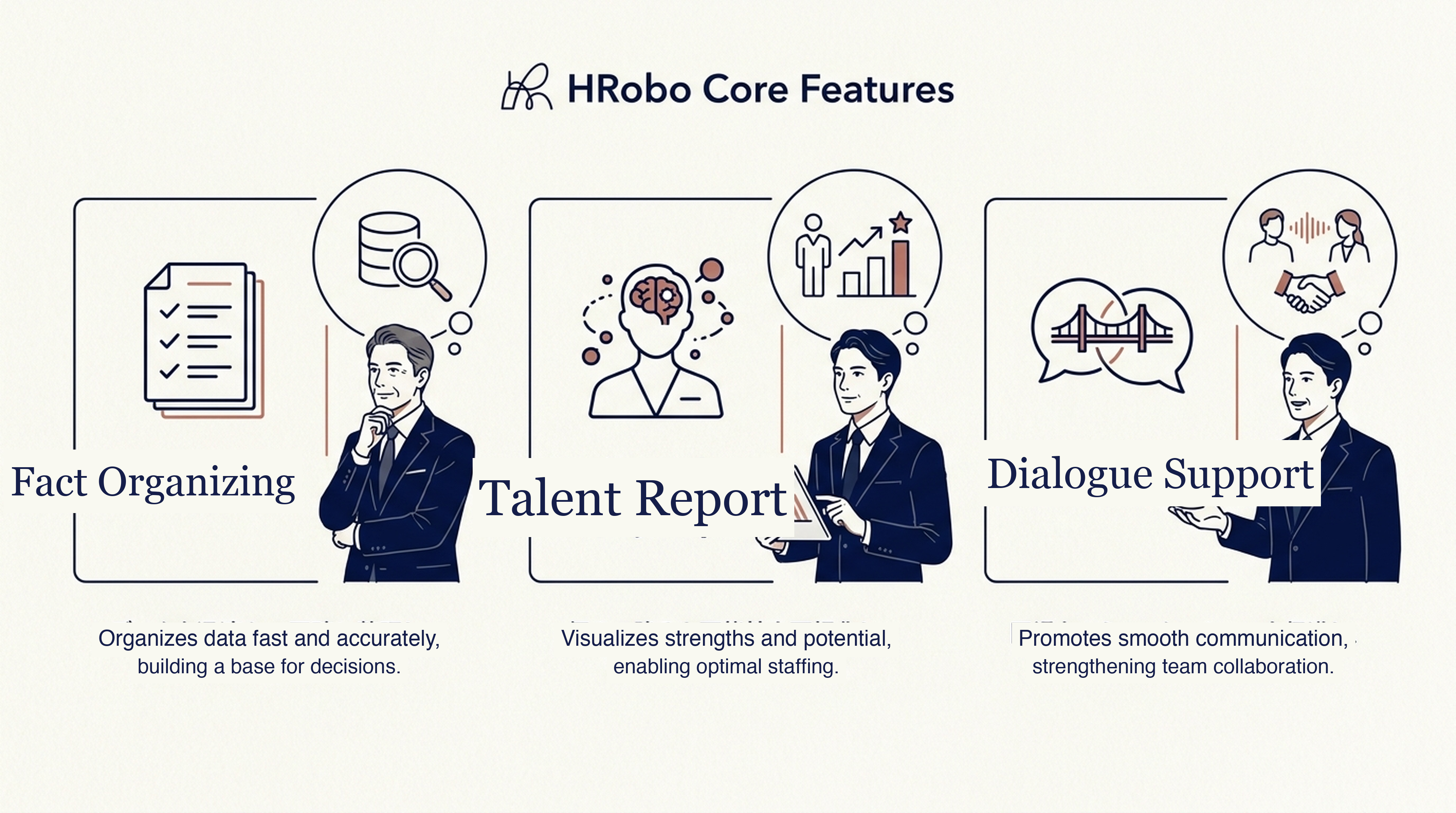
TALENT REPORT
Putting each person, one by one, into words
Connecting to Slack, Teams, and email, HRobo reads each observation axis for "recent topics," "strengths," and "signs worth watching," and continuously compiles them into a talent report.
- Organize topics, strengths, and signs per observation axis
- Use multiple observation-axis templates across roles and functions
- Set generation frequency freely from daily to monthly, or generate instantly by hand
- Cross-cutting views filtered by department, period, and role
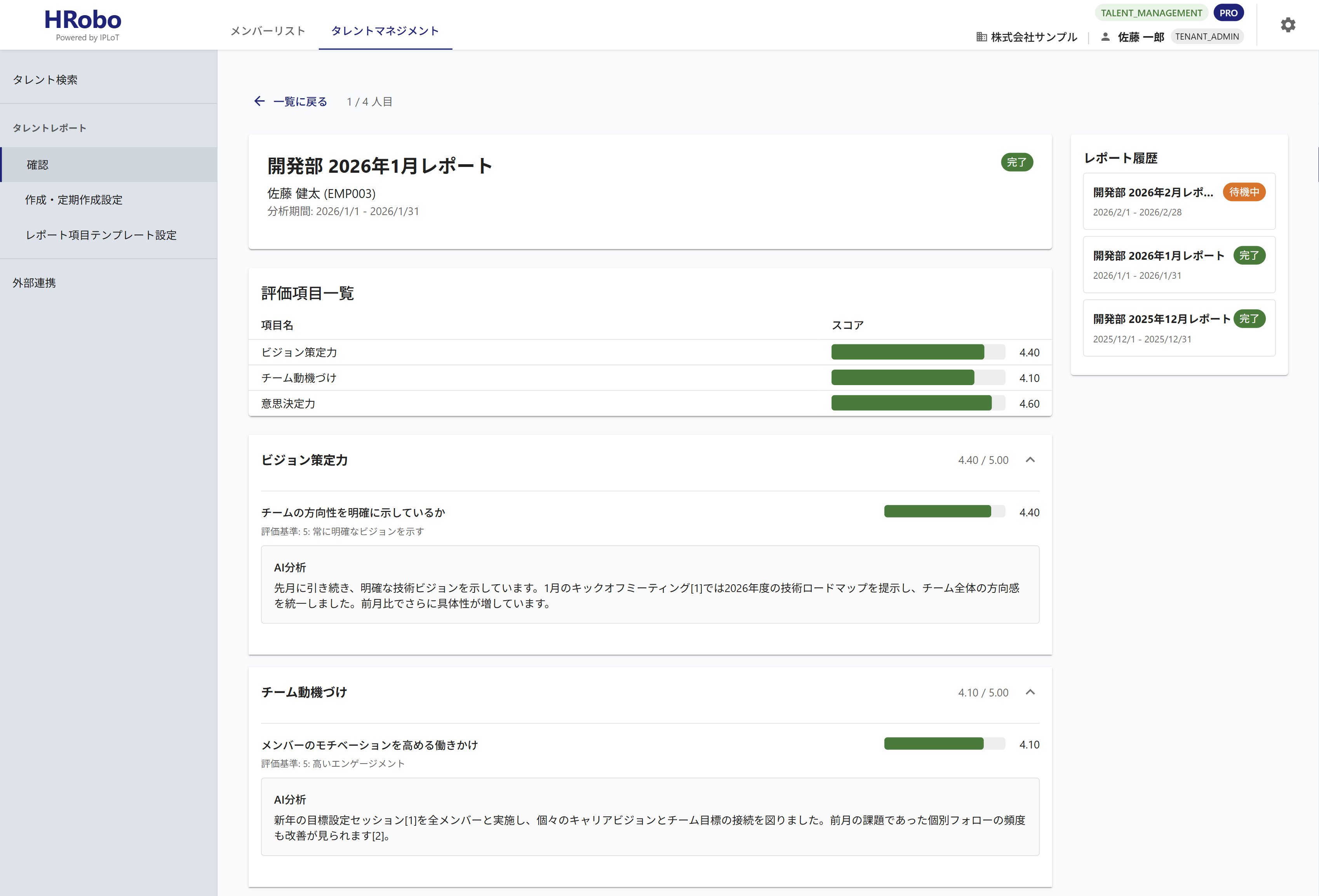
CITATIONS
Always trace why it was written that way
Key statements in a report come with direct links to the original messages they're based on. The moment someone asks "why is it written this way?", you can open the AI's output all the way down to the actual message. It becomes shared reference material for dialogue that you can even show to the person themselves.
- Jump from a key statement to its original message in one click
- Transparent design built on the premise of disclosure to the person
- Accountability for AI output guaranteed at the design level
- Answer "why?" instantly when asked
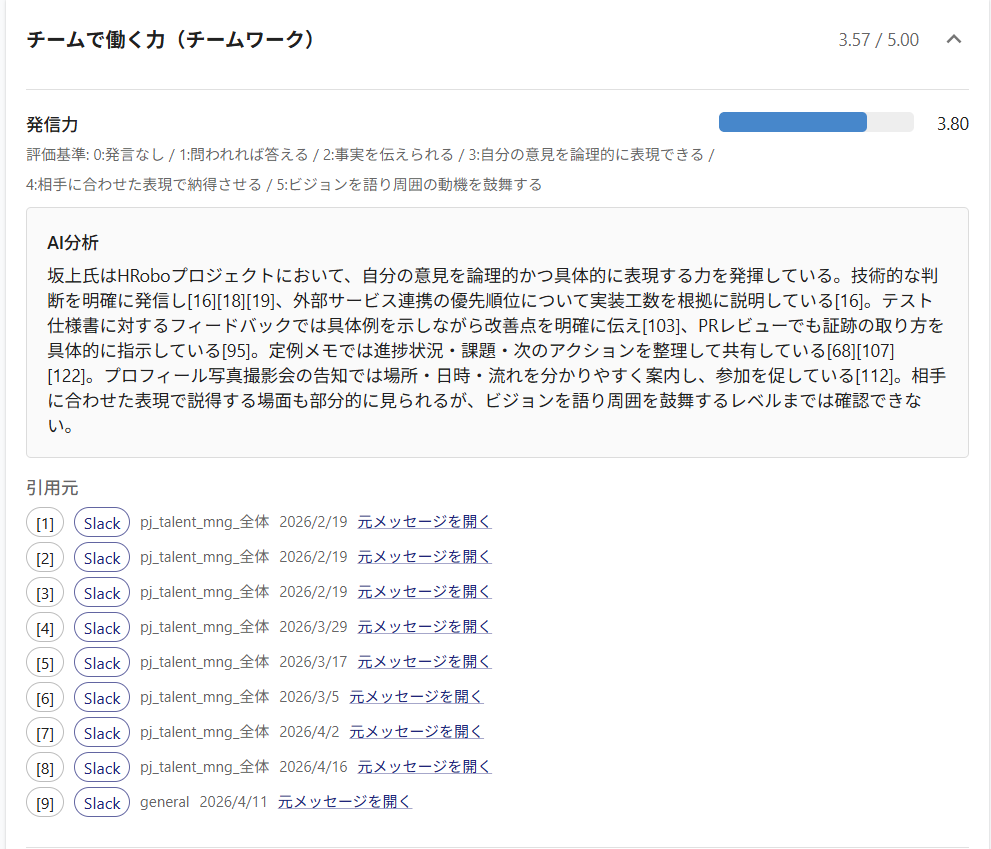
TALENT SEARCH
"Do we have someone like this?" — in natural language
"Someone with strong sales skills who's also been involved in developing junior staff" — just ask in your everyday words and you get candidates along with the reasons and the supporting statements behind them. You can keep narrowing down with additional conditions as you look at the results. Leadership can query internal talent data directly.
- Write your conditions in everyday words and get candidates with reasons
- Keep narrowing down with extra conditions as you view the results
- For finding new-business leads and successor candidates
- Decision-makers can search internal talent themselves
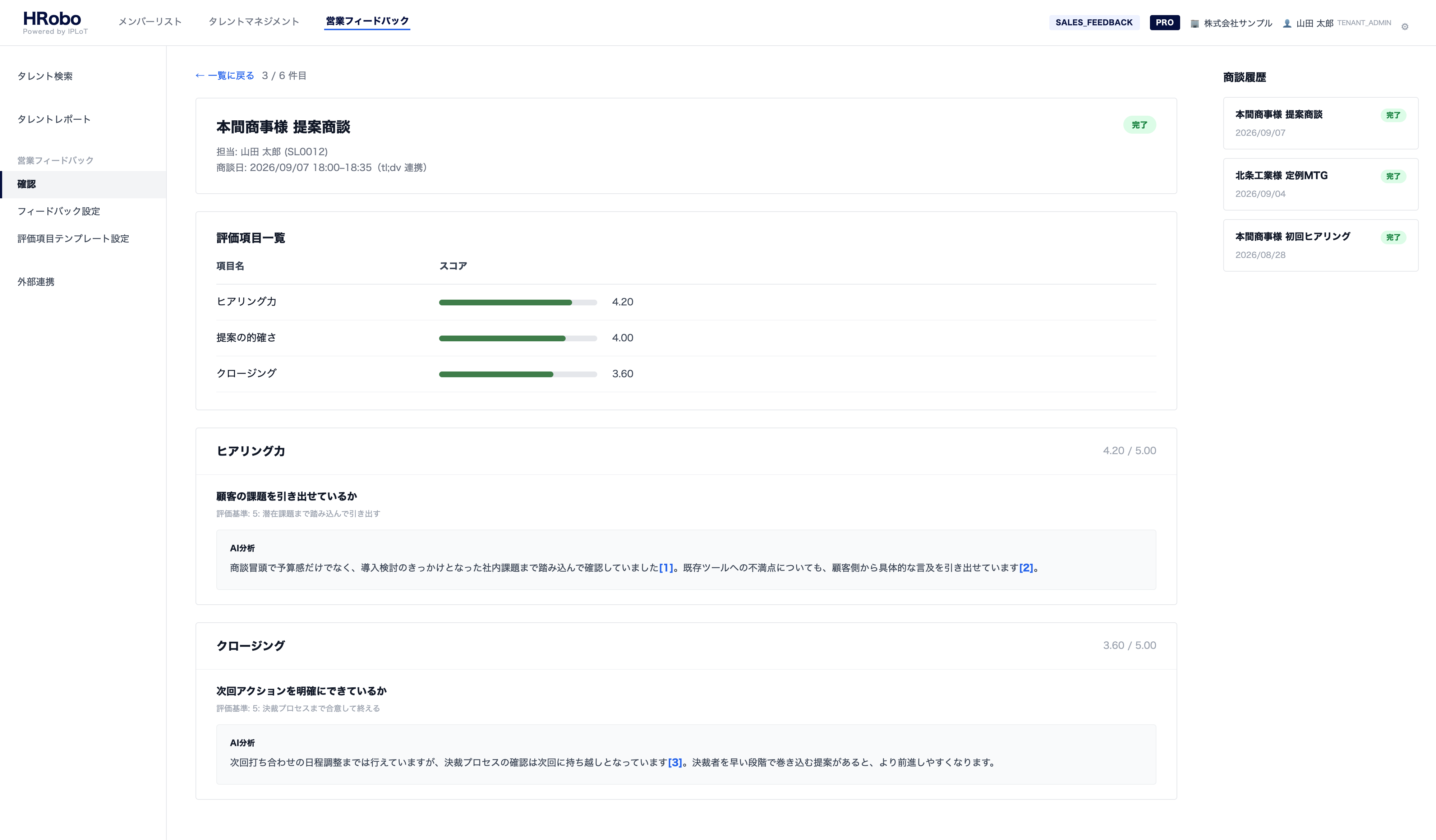
SALES FEEDBACK
Turning each deal into feedback that sticks
From tl;dv and web-meeting transcripts, HRobo organizes what went well and what to improve in each sales conversation into AI-written feedback, backed by the actual statements behind it. You design the axes yourself — listening, proposal, closing, and more.
- Organizes "what went well" and "what to improve" per deal
- Shows why, with direct quotes from the conversation
- Design your own axes — listening, proposal, closing, and more
- Turns individual growth into stronger team-wide sales performance
─ MANIFESTO
The one who decides
is always a person.
All HRobo does is organize the words.
A person always stands at the place of judgment and dialogue.
The AI merely prepares the shared reference material opened there.
That accumulation is what turns talent into the company's competitive edge.
FRAMEWORK
Observe along axes set by your own yardstick
Your evaluation system, competency model, and behavioral guidelines can be dropped straight into observation-axis templates.
─ FULLY CUSTOMIZABLE
Observe your people in your own words.

Define observation axes freely per role and function
Reflect role-specific axes directly in the AI — "building trust with customers" for sales, "the rationale behind tech choices" for engineers, "proactive support" for CS, and so on.

Reflect your existing evaluation system as is
Bring your values, grade system, behavioral guidelines, and competency model straight in as observation-axis templates.
Add, remove, and edit axes anytime
Continuously tune your observation-axis templates as your organization and strategy change. Whether it's a half-yearly review or adjustments while operating, it's all up to you.
Adjust weighting and observation periods
Flexibly set the importance of each axis and the period under observation. You can also use separate templates per role, position, and stage.
─ BASE TEMPLATE
As a base template, we also provide METI's "Fundamental Competencies for Working Persons" — 3 abilities and 12 elements. If you're unsure where to start from scratch, you can begin here and add your own axes.
ACTION
The ability to step forward
~Persistence even in the face of failure~
Initiative
The drive to take things on proactively
Influence
The ability to engage and rally others
Execution
The ability to set goals and act on them reliably
THINKING
The ability to think things through
~Questioning and thinking things through~
Problem-finding
The ability to analyze the situation and surface goals and issues
Planning
The ability to map out and prepare a problem-solving process
Creativity
The ability to generate new value
TEAMWORK
The ability to work in a team
~Cooperating with diverse people toward a shared goal~
Communication
The ability to convey your opinions clearly
Active listening
The ability to listen carefully to others
Flexibility
The ability to understand differences in views and positions
Situational awareness
The ability to understand your relationship with those around you
Discipline
The ability to follow rules and keep commitments to others
Stress control
The ability to deal with the sources of stress
Source: METI, Fundamental Competencies for Working Persons
USE SCENES
Where it's being used
HRobo reports are opened across all kinds of internal settings as shared reference material for judgment and dialogue.
Prepping for a 1on1
Read through the "recent topics" and "signs worth watching" in the report before heading into a 1on1. Because you can see what to ask beforehand, the quality of the conversation changes.

Discussing placement and promotion
Ask in natural language whether "there's an internal candidate for the next business lead." Decision-makers can touch the talent data directly, right in the meeting room.

Supporting the growth of new managers
Make the "observing your members" that veterans did implicitly visible as a report. New managers can learn what to focus on in their first few months.
As reference material for review meetings
For organizing the facts before sitting down with the person. HRobo doesn't make the call — it provides shared reference material that supports the discussion in the room.

Putting hiring requirements into words
Define "the kind of person your current organization is missing" from internal data. It raises the precision of your hiring persona design and the briefs you give to agencies.

Catching attrition signals early
A drop in message volume, thinning relationships, a shift in tone. "Signs worth watching" quietly surface in the report. You can design opportunities for dialogue earlier.
STEP
How to get started
Just pick from a template or design your own observation axes. With the product alone, you can be operating as soon as the same day.
Design your observation axes in-house
Pick from the prepared templates, or define your own evaluation system and competency model directly as observation axes. In as little as 30 minutes, you can reflect your own yardstick in the AI.
Just connect your business tools and you're live
Simply connect Slack / Teams / email. Reports start accumulating automatically from your daily exchanges. People on the frontline take on no new workload.
Refine your observation axes as you go
Keep refining your observation axes in-house while watching the reports. Just update the observation-axis templates as your organization and strategy change. You can keep operating at your own pace with the product alone.
When needed, IPLoT consultants provide hands-on support
From designing observation axes to refining operations and leading organizational analysis. When you need expert support walking alongside you, IPLoT's HR consultants help as a set. Whether you operate with the product alone or adopt it with a consulting package is yours to choose, to fit your situation.

─ FOR EVERYONE WHO STAYS UNSEEN
on contributions that go unseen.
SECURITY & TRUST
How we handle your data
HRobo is a tool that handles employee communication. As the premise of trust, we commit to the following.
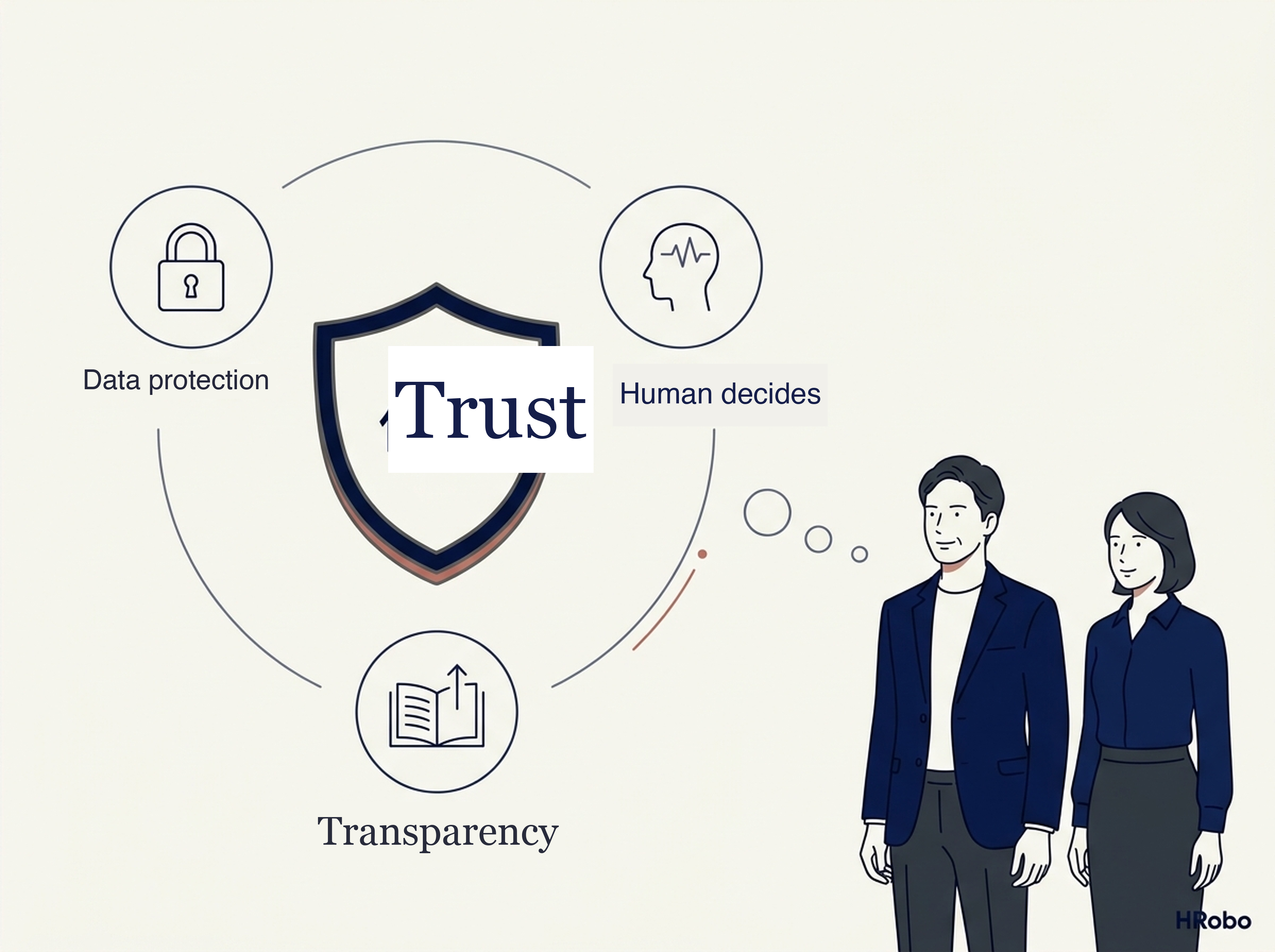
POLICY 01
Report design you can disclose to the person
Reports are written on the premise that they can be shown to the person themselves. They aren't data to be hidden and hoarded — they're operated as shared reference material for dialogue.
POLICY 02
Credentials stored encrypted
Slack and Teams credentials and message logs are encrypted with AWS KMS and stored separately per company. Your data is managed so that it never mixes with another company's data.
FAQ
Frequently Asked Questions
No. HRobo only goes as far as "organizing the facts" and "putting them into words as a talent report." Evaluation calls and personnel decisions are always made by people. Use the reports as shared reference material for judgment in settings like 1on1s and review meetings.
HRobo is designed for "organizing facts" and "supporting observation" — the AI never unilaterally makes evaluations or judgments. The scope of referenced information, viewing permissions, and retention periods can all be configured in detail on your side. Data is stored in domestic regions and is never used for external training.
Yes, we recommend it. Because the citation feature ties every statement back to its evidence, the reports work as shared reference material in 1on1s and review meetings with the person. They are also effective as a starting point for the person's own career conversations.
In principle, no. HRobo draws on the Slack and Teams exchanges that are already happening day to day, so members don't need to open a new tool and enter anything.
In addition to everyday business tools like Slack / Microsoft Teams / email / Google Workspace, it can also integrate with major HR systems such as HRMOS, SmartHR, and freee HR. The scope of integration can be expanded in stages to match your operations.
It works for organizations from around 30 people up to enterprises with thousands of employees. You can also take a small-start approach, beginning with a few departments and rolling out company-wide as you confirm the impact.
You can start operating with observation-axis design (30 minutes and up) and connecting your business tools (about 5 minutes). If you need tuning to match your evaluation system or competency model, or integration with existing systems, you can expect to be in full operation in roughly 2–6 weeks.
It varies depending on the number of users, the range of connected systems, and the scope of customization. We offer everything from small-start-friendly plans to comprehensive enterprise plans. Get in touch and we'll provide an estimate tailored to your scale and use case.